

FTC Brings Dozen AI-Washing Enforcement Cases in 2025, Targeting Overstated AI Claims
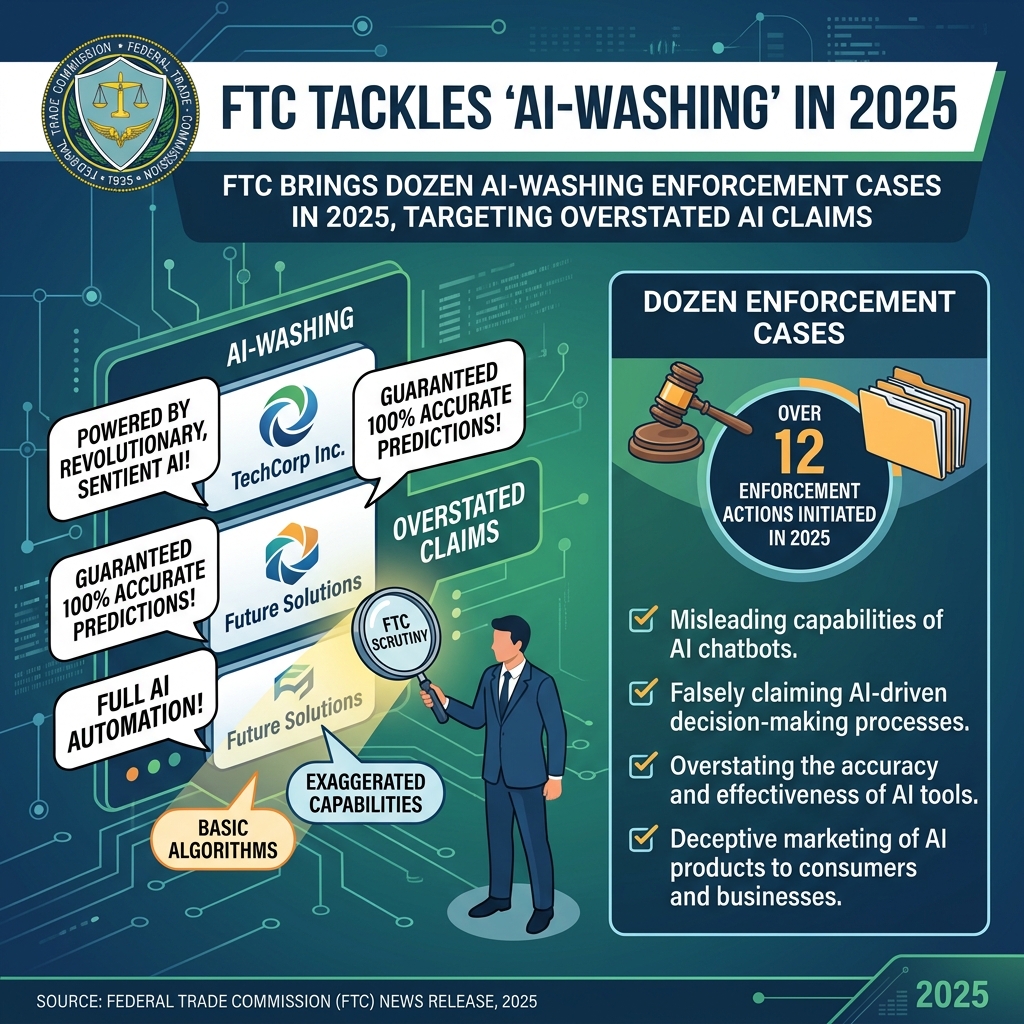
FTC Brings Dozen AI-Washing Enforcement Cases in 2025, Targeting Overstated AI Claims
AI-washing refers to the practice of overstating the sophistication, autonomy, or effectiveness of AI-based products and services to attract investment, customers, or media attention. The FTC’s 2025 actions covered a range of conduct: companies claiming their products used machine learning when they relied on manual processes, marketing materials that attributed capabilities to AI systems that the underlying technology could not support, and earnings opportunity claims tied to AI tools that were not substantiated by verifiable performance data. The agency’s enforcement authority in these cases derives primarily from Section 5 of the FTC Act, which prohibits unfair or deceptive acts or practices, without requiring the passage of AI-specific legislation.
The cases brought in 2025 followed a series of agency guidance documents issued between 2023 and 2024 that put companies on notice that AI-related claims would be evaluated under the same substantiation standards applied to other product representations. Those guidance documents identified several recurring risk areas: vague claims about AI capabilities lacking technical specificity, comparative performance claims unsupported by empirical testing, and implied endorsements that suggested regulatory approval or independent verification of AI systems where none existed. The 2025 enforcement actions indicate that the agency moved from guidance to active investigation across each of these categories.
The compliance implications extend beyond the technology sector. Retail, healthcare, financial services, education technology, and marketing automation companies have all integrated AI-adjacent language into product descriptions and promotional materials in ways that may not withstand FTC scrutiny. Legal practitioners advising on advertising compliance, product claims, and consumer-facing disclosures are reviewing existing materials against the substantiation standards applied in the 2025 enforcement actions. The question in most cases is not whether a product uses AI, but whether the specific claims made about what that AI does are accurate, verifiable, and not likely to mislead a reasonable consumer.
For companies that received civil investigative demands or are operating in markets adjacent to those already subject to FTC action, the priority areas are claim substantiation documentation, review of earnings representations tied to AI features, and assessment of third-party marketing materials produced by affiliates or resellers that may carry brand liability. Where AI capabilities form a material part of a product’s value proposition, legal review of the technical accuracy of marketing language is no longer optional risk management — it is a baseline requirement in the current enforcement environment.
State attorneys general have separately indicated interest in AI-related consumer protection enforcement, with several states pursuing parallel investigations under state unfair business practices statutes. The combination of federal and state enforcement activity creates a multi-jurisdictional compliance risk for companies operating national marketing programmes.
Businesses seeking legal guidance on FTC compliance, AI-related consumer protection obligations, or technology law matters can search for qualified attorneys by jurisdiction and practice area through Global Law Experts, an international legal directory covering 140+ countries.
John Martin
Global Law Experts
870 977 1000
email us here
Visit us on social media:
LinkedIn
Instagram
Facebook
YouTube
X
Legal Disclaimer:
EIN Presswire provides this news content "as is" without warranty of any kind. We do not accept any responsibility or liability for the accuracy, content, images, videos, licenses, completeness, legality, or reliability of the information contained in this article. If you have any complaints or copyright issues related to this article, kindly contact the author above.
