

Government Launches 2027–2030 National Medium-Term Plan and Presents Results of PED Implementation
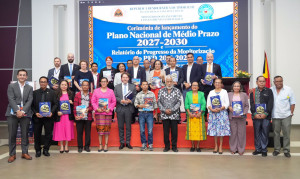
On October 1st, 2026, at the Ministry of Finance in Dili, the Government launched the National Medium-Term Plan (PMP – acronym in Portuguese) 2027–2030 and the Monitoring Progress Report for the Strategic Development Plan (PED – acronym in Portuguese) 2011–2024. Prime Minister Kay Rala Xanana Gusmão presided over the ceremony, which marked the start of the final phase of implementing the 2011–2030 PED, including defining development priorities and targets for the next four years.
Approved by the Council of Ministers on September 2nd, the 2027–2030 PMP sets out ten national priorities and organises Government action around four pillars: economic diversification; infrastructure; social and human capital development; and institutional development. The national priorities will be directly monitored by the Council of Ministers and will guide annual budgets.
At the ceremony, the Prime Minister stated that the two documents constitute “a national moment of accountability and the renewal of a political commitment” and represent “a pact: the guarantee that the vision of 2011 remains alive and that the final phase of the Strategic Development Plan will be carried through to completion with discipline and unity of purpose.”
The Report assessed 199 short- and medium-term targets across the main sectors of the PED. Of these, 106 (53.3%) were completed or had reached an advanced stage of implementation, 43% were partially implemented, and around 3% showed limited implementation.
Among the results achieved, improvements in social indicators and infrastructure stand out. Childhood vaccination reached 98%, and the national literacy rate reached 72.4%. Electricity reaches more than 99% of cities and hamlets; roads have been built to improve connections between communities; Tibar Bay Port is now operational; the modernisation of the Presidente Nicolau Lobato International Airport is underway; and the Timor-Leste Submarine Cable has established a direct national connection to international digital networks.
The Report also identifies areas where results remain below the defined objectives. Despite the increase in registered businesses, improvements in agricultural productivity, and the creation of 14,400 jobs in the formal private sector between 2021 and 2024, economic growth has not yet reached the pace required to generate sufficient employment and opportunities.
“There are still too many young Timorese struggling to find work. Too much economic activity remains dependent on the State. And much of what we consume is imported rather than produced in Timor-Leste,” stated the Prime Minister, who identified the building of “a strong and productive economy” as the next phase of national development.
In this regard, the PMP aims to achieve annual non-oil GDP growth of 6% by 2030 and 7.5% thereafter, create between 5,000 and 7,000 new formal private-sector jobs per year, and increase the private sector’s share of total investment by 15 to 20 percentage points of non-oil GDP.
The Plan includes measures to expand access to finance, such as a credit guarantee scheme and a blended finance mechanism, which are designed to generate US$40 million in additional loans for micro, small, and medium-sized enterprises. Public-private partnerships are also planned in the housing, digital infrastructure, and renewable energy sectors, along with the creation of the National Development Bank.
The Prime Minister also highlighted the private sector’s role in this new phase of development: “We now need Timorese businesses to produce more, invest more, and employ more people. We also need responsible foreign investment that brings capital, skills, and access to markets.”
Timor-Leste’s accession to ASEAN and the World Trade Organisation expands Timorese companies’ access to markets, investment, education, and skills. However, the Prime Minister stressed that “accession alone will not transform our economy”, emphasising the need to develop companies capable of competing, producing goods and services, and creating jobs in Timor-Leste.
Human capital development is also a PMP intervention area, achieved through investment in education, health, and vocational skills. The Plan also establishes that development must encompass women, persons with disabilities, youth, and families in rural communities.
In his speech, the Prime Minister framed these priorities as part of the objective to transform national resources into a more productive economic base. “Our task is to convert that wealth into a productive economy, rather than allowing our economy to depend on spending from the Fund,” he stated, adding that “sovereignty is not a slogan. It requires the economic strength necessary to make our own decisions in our own interest. Sovereignty without economic strength remains incomplete.”
The PMP will be linked to the annual budget cycle from 2027 onwards and will strengthen monitoring and inter-ministerial coordination. The Ministry of Planning and Strategic Investment will work with the Ministry of Finance to ensure the Plan's priorities are integrated into the budgetary process.
The Prime Minister emphasised that the Plan’s execution must be judged by its concrete results for the population, stating that “the Timorese people will not evaluate the success of this Plan by the number of targets presented in its tables. They will evaluate it by the changes that occur in their lives.”
The ceremony, held under the theme “Strengthening Strategic Planning for Sustainable and Inclusive Development”, was attended by members of the Government and the National Parliament, representatives of the diplomatic corps, development partners, the private sector, civil society, and the academic community.
Legal Disclaimer:
EIN Presswire provides this news content "as is" without warranty of any kind. We do not accept any responsibility or liability for the accuracy, content, images, videos, licenses, completeness, legality, or reliability of the information contained in this article. If you have any complaints or copyright issues related to this article, kindly contact the author above.
